
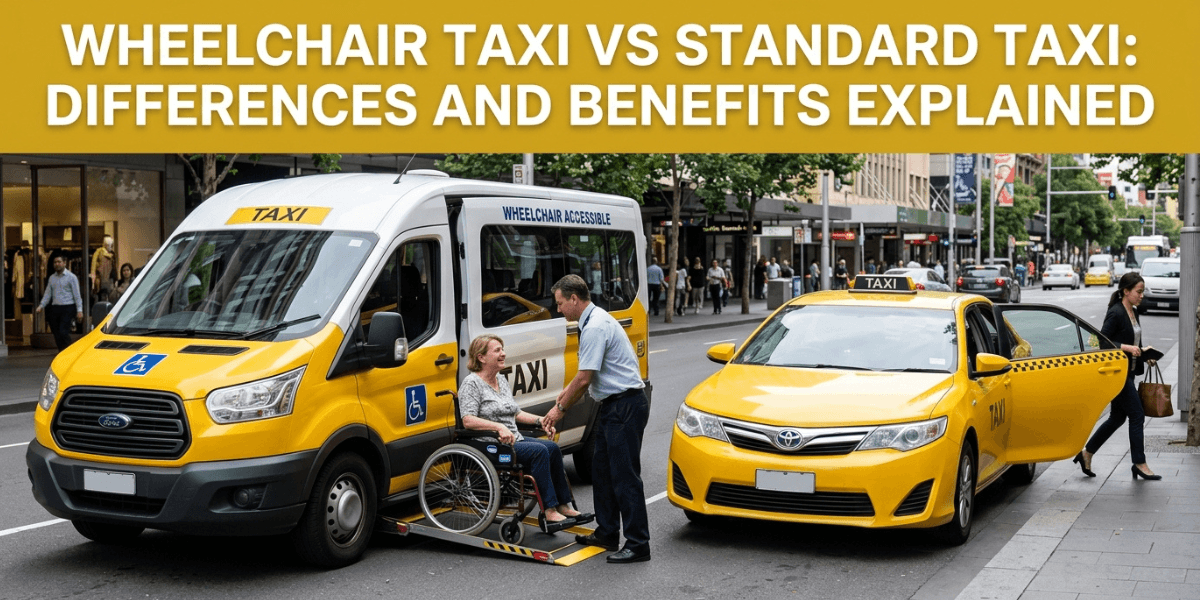
Not every taxi is built to accommodate every passenger, and for people who use wheelchairs or have mobility challenges, this can turn a simple journey into a logistical headache. Wheelchair accessible taxis are designed specifically to bridge this gap, offering features that standard taxis simply cannot provide. While both options aim to get you from point A to point B, the differences between them extend far beyond the vehicle itself, encompassing accessibility, comfort, safety, and overall passenger independence.
This guide breaks down what sets wheelchair taxis apart from standard taxis, the benefits each option offers, and how to choose the right one for your specific needs.
What Is a Wheelchair Taxi and Who Needs One?
A wheelchair taxi, formally known as a Wheelchair Accessible Vehicle (WAV), is a purpose-built or specially modified vehicle designed to carry passengers who use wheelchairs or mobility aids. The defining feature is simple: the passenger remains in their wheelchair for the duration of the trip. There is no transferring to a standard seat, no lifting, and no struggling to fold the chair into a boot.
According to UK government figures from 2024, just 11.5% of all licensed vehicles in England are wheelchair accessible. Outside major cities, that proportion drops even further. For passengers in Hertfordshire towns like Hatfield and Stevenage, this scarcity makes finding a genuinely equipped local provider all the more important.
Key Differences Between Wheelchair & Standard Taxis
Many people assume all taxis provide a similar travel experience. In reality, wheelchair-accessible vehicles (WAVs) are specifically designed to meet the needs of passengers with limited mobility, while standard taxis are built for able-bodied travellers.
| Feature | Wheelchair-Accessible Taxi (WAV) | Standard Taxi |
| Vehicle Entry | Equipped with a ramp or lift for easy wheelchair access | Standard doors with no wheelchair-access system |
| Wheelchair Accommodation | Passengers can remain in their wheelchairs throughout the journey | Passengers typically need to transfer to a vehicle seat |
| Interior Space | Spacious cabin designed for wheelchairs and mobility equipment | Limited space with fixed seating arrangements |
| Door Width | Wider door openings for easier access | Standard-sized doors |
| Safety Equipment | Wheelchair restraints, anchor points, and safety harnesses | Standard passenger seat belts only |
| Comfort Level | Designed to provide greater comfort for wheelchair users | Suitable primarily for passengers without mobility aids |
| Driver Training | Drivers often receive disability awareness and accessibility training | General taxi driver training |
| Best Suited For | Wheelchair users and passengers with mobility challenges | Able-bodied passengers and general travel needs |
While both vehicle types provide transportation, a WAV offers the accessibility, safety, and comfort features required for passengers who rely on a wheelchair, making it the more practical choice for inclusive travel.
Challenges Faced with Standard Taxis
For wheelchair users across Harpenden and St Albans, the limitations of a standard cab are not minor frustrations; they are genuine barriers to independent travel. Here are what passengers typically encounter:
- Transferring out of the wheelchair is often painful, unsafe, and requires physical assistance, removing any chance of travelling independently.
- Storing the wheelchair in a standard boot is rarely practical. Manual chairs may fold with help, but powered chairs almost never fit.
- Narrow door openings on conventional vehicles are too tight for most wheelchairs, making entry impossible regardless of how willing the driver is to assist.
- No specialist training means standard drivers, however helpful, are simply not equipped to assist passengers with complex mobility needs safely.
- Limited availability remains a serious issue. In 2024, only 2.2% of private hire vehicles in England were wheelchair accessible, giving passengers an extremely small pool of suitable options.
Each of these problems feeds into the others, creating a transport experience that fails wheelchair users at almost every stage. Fortunately, Gold Line Taxis provides 24/7 wheelchair-accessible transport across Hertfordshire. Book your journey today with our dependable taxi service in St Albans to travel with the comfort and care you deserve.
Accessibility Features in Wheelchair Taxis
Wheelchair Accessible Vehicles (WAVs) are specifically designed to remove the barriers often found in standard vehicles. They provide a safer, more convenient travel experience for passengers with mobility needs, ensuring comfort from pickup to drop-off.
Easy Access and Safe Boarding
A properly equipped WAV includes either a fold-out or hydraulic ramp, allowing passengers to board smoothly without lifting or transferring. The lowered floor design creates a gentler entry angle, making access easier and more comfortable. Wide door openings can accommodate both manual and powered wheelchairs, helping passengers enter and exit with minimal difficulty.
Comfort and Space Comparison
When compared with standard taxis, WAVs offer significantly more interior space. Passengers can remain seated in their own wheelchairs throughout the journey without feeling restricted. The spacious cabin provides greater comfort, particularly during longer trips, while also allowing room for carers, companions, or additional mobility equipment when needed.
Safety Features and Professional Driver Support
Inside the vehicle, floor-mounted anchor points and specialised restraint systems secure the wheelchair firmly in place, preventing movement during braking or cornering. Drivers of WAVs in the UK receive disability awareness training that covers safe ramp operation, correct wheelchair securing procedures, and respectful passenger assistance. For regular travellers in areas such as Stevenage and Hatfield, this level of professionalism helps ensure a consistently safe and comfortable journey.
Benefits of Choosing a Wheelchair Taxi
The advantages of travelling in a properly adapted vehicle extend well beyond the physical. Passengers across Hatfield, Harpenden, and Stevenage can attend medical appointments, commute to work, visit family, and manage everyday errands without relying on others to assist them at every stage. That level of independence has a direct and meaningful effect on confidence, mental well-being, and social participation.
Safety You Can Rely On
A correctly secured wheelchair in a purpose-built vehicle is far safer than attempting a transfer into a standard cab. Professional WAV drivers are trained to manage every aspect of the journey with the passenger’s safety as the priority, from ramp deployment to final drop-off.
Consistency for Regular Journeys
Pre-booking a wheelchair taxi guarantees the right vehicle and a trained driver at the agreed time. For passengers who travel regularly to appointments or need airport transfers from nearby terminals, that dependable consistency removes a significant source of daily stress.
A Service Built Around Dignity
Travelling in your own chair, with a trained driver and a vehicle designed for your needs, means every journey is handled with genuine care. That standard of dignity should never feel like a bonus; it should be the baseline for every passenger, every time.
Frequently Asked Questions
Can a carer travel alongside a wheelchair passenger in the same vehicle?
Yes, WAVs are designed with enough space for the passenger in their chair plus a travelling companion. Always mention this when booking so the right vehicle size is arranged.
Do I need to book a wheelchair taxi in advance?
Advance booking is strongly recommended, particularly for airport transfers or early morning journeys. It guarantees the right vehicle and a trained driver will be ready at your confirmed time.
Are powered wheelchairs accommodated in WAVs?
Most WAVs can accommodate powered chairs, though dimensions vary between vehicles. Always confirm your chair’s size and weight with the operator at the time of booking.
Is a wheelchair taxi more expensive than a standard cab?
Fares may differ slightly due to the specialist nature of the vehicle. Many reputable local providers keep pricing competitive, and some passengers may qualify for travel assistance schemes to help with costs.
Conclusion
A standard taxi works perfectly well for most passengers, but for wheelchair users across St Albans, Harpenden, Hatfield, and Stevenage, it is simply not a viable option. Wheelchair-accessible taxis close that gap with purpose-built vehicles, trained drivers, and a service designed entirely around the passenger. The difference is not cosmetic; it is the difference between having access to transport and being left without it.
Gold Line Taxis operates around the clock with fully equipped vehicles and experienced drivers ready to help. Contact our team today for reliable airport taxis from Stevenage and experience a service that truly works for every passenger!
